Showing posts with label Freedom of press. Show all posts

May 26, 2017

24 hours later: What we know about the blocking of Mada Masr’s website

Mirrored from www.madamasr.com now blocked in Egypt:
 
 
Access to Mada Masr’s website via most of Egypt’s internet service providers (ISPs) has been blocked since Wednesday evening.

The country’s official state news agency, MENA, quoted a high-level security source on Wednesday night as saying that access to 21 websites, which had disseminated “content that supports terrorism and extremism and deliberately spreads lies,” had been blocked in Egypt in accord with “relevant legal proceedings.”

Mada Masr has not been officially informed that any party has taken official or legal measures against it.

Several other websites have also been blocked, including two Egyptian publications: Masr al-Arabiya and the website of the print weekly Al-Mesryoon. The list also includes some Qatari or Qatar-funded news outlets that support or are managed by the Muslim Brotherhood, principal among them Al Jazeera and Huffington Post Arabic, in addition to the official website for Palestinian political movement Hamas.

The statement from the high-level security source was circulated to newspapers and wire services from the office of the presidency, Mada Masr has learned. Speaking on the condition of anonymity, Interior Ministry officials have told reporters that they had nothing to do with drafting or executing the decision to block the websites.

The move to block access to a range of websites affiliated with Qatar and the Muslim Brotherhood in Egypt happened in conjunction with Saudi Arabia and the United Arab Emirate’s decision to block many of the same sites. Egyptian authorities added Mada Masr to its list, however.

Mada Masr’s website is still accessible in Saudi Arabia and the UAE.

In response to Mada Masr’s inquiry into the restriction of access to its website, Supreme Media Regulatory Council Secretary General Ahmed Selim said that the council, formed in April, has yet to take over control of digital media outlets. He directed inquiries to the Communication and Information Technology Ministry.

Mada Masr attempted to contact National Telecom Regulatory Authority head and Communication and Information Technology Minister Yasser al-Qady. His secretary acknowledged receipt of the questions and said a further response would be pending. As of publication, Mada has yet to receive a reply.

Mada also contacted newly elected Journalists Syndicate head Abdel Mohsen Salama, who said he was monitoring the situation closely but was not aware that access to Egyptian websites had been blocked. He asked Mada to draft a memo detailing the circumstances of the incident, which he would then submit to the Supreme Media Regulatory Council.

Faced with an absence of information from official sources, Mada Masr turned to technical experts, who diagnosed an RST injection attack as the reason for the inability to access the website.

What is a RST injection attack?

The internet is a network made up of computers and the electronic messages and packets of IP (internet protocol) data that pass between them. The transmission of the information that constitutes this system is formalized in various systems called “protocols.”

IP is the most basic protocol used on the internet, and it is usually coupled with TCP (transmission control protocol), which is used for web browsing and email. Data on computers is broken down into a series of ones and zeros. Each zero or one represents the smallest data unit in the language of computer communication. Data packets sent via TCP contain a block of information called a TCP header, which includes details concerning the sending and receiving parties in the exchange. In normal communications, the TCP header’s bit is set to zero and has no effect on communication. If the value is changed to one, the computers party to the exchange are notified that they should stop using the TCP connection and should no longer send any more packets using the connection’s identifying numbers.

A third party can monitor TCP packets being sent from various points of a connection and then interject a forged packet containing a TCP reset command that will change the bit of the header from zero to one. The connection is interrupted with each attempt to complete the communication.
One of the most famous examples of a RST injection attack involves the firewall that China uses to censor and suspend access to a number of websites.

This is the type of interruption which has blocked access to Mada Masr’s website in Egypt.

Continuing attempts to control the internet

Attempts to open the sites that have been blocked in Egypt have yielded a range of behaviors across ISPs. For example, most sites can be accessed via Noor ADSL.

Mada Masr has received various reports from users, pointing to the fact that the block is not uniformly in force, varying across the same ISPs at different geographical locations and times. This suggests that the RST attack has been decentralized and enforced by individual ISPs.

The recent interference intersects with the government’s decision to block The New Arab website last year. An October 2016 report on anomalies in Egypt’s online ecology conducted by the Open Observatory of Network Interference (OONI) — an international network operating under the Tor Project that monitors internet censorship, traffic manipulation and signs of surveillance — found that the injected RST packet observed to obstruct user-server communication with The New Arab website had the same “static IP identification (IP ID) value of 0x3412 as the injected RST packets” used in an attempt to interfere with Tor in Egypt. This similarity is significant, as The New Arab, which is Qatari funded and sympathetic to the Muslim Brotherhood, is known to be blocked by the Egyptian government, suggesting that a state agency using the same server location conducted the RST injection attacks on Tor.

The same technique was used in December to disrupt Signal, the messaging and voice calling application supported by Open Whisper Systems’ encryption protocol.

Much of this evidence suggests an image of the Egyptian government as directly involved in a practice of mass surveillance, as documented in a January report published by Mada Masr.
These events are part of a wider history of the state’s attempt to control the internet, a principal concern since the January 2011 revolution and one that has risen to the surface in numerous arrests made recently in connection with the administration of Facebook pages. The government is also currently preparing legislation to combat cybercrime.

In a joint policy report published in June 2016 under the title “Anti-Technology,” the Egyptian Initiative for Personal Rights (EIPR), Support for Information Technology Center, and the Association for Freedom of Thought and Expression (AFTE) wrote that the law “violates the principle of equality before the law and contains penalties regarding the use of information technology.”

In April 2016, sources with direct knowledge of discussions between Facebook and the Egyptian government told Reuters that Egypt had blocked Facebook’s Free Basics internet service at the end of 2015 after the US company refused to give the state the ability to monitor users.

A month earlier, in March, Google published a statement asserting that it had became “aware of unauthorized digital certificates for several Google domains” issued by an intermediate certificate authority held by Egyptian company MCS Holdings, which had been contracted by the China Internet Network Information Center (CNNIC) to issue certificates for domains they had registered.

“Rather than keep the private key in a suitable HSM, MCS installed it in a man-in-the-middle proxy,” the Google statement read. “These devices intercept secure connections by masquerading as the intended destination and are sometimes used by companies to intercept their employees’ secure traffic for monitoring or legal reasons.”

In a previous report, Mada Masr highlighted leaked documents that emerged after Cairo’s State Security headquarters was stormed by protesters in March 2011, which showed that MCS had been corresponding with Egypt’s State Security Investigation Service (SSIS) to obtain the FinFisher system, surveillance software offered by the British-German company Gamma International.

The move to block and shut down websites is a new step from these recent forms of interference. The government is turning from mass surveillance, to directly intervening to block access to the websites of Egyptian companies operating in Egypt, including Mada Masr and Masr al-Arabiya.

The legality of blocking access to websites

Access to websites in Egypt can be legally curtailed in two ways, says Amr Gharbeia, a technology and human rights researcher at the EIPR. The first is tied to the issuance of an order either by a prosecutor or investigating judge, or, during a state of emergency, when the president can move to block access in his capacity as military governor. President Abdel Fattah al-Sisi declared a three-month state of emergency on April 9.

The second mechanism concerns the anti-terrorism law, Article 29 of which stipulates a five-year prison term for anyone who “establishes a telecommunications or internet site to promote ideas or beliefs that encourage committing terrorist acts or to broadcast [information] to mislead security agencies or influence the course of justice with regard to a crime of terrorism.”

“If there is a website being investigated for one of the aforementioned crimes, Article 49 of the anti-terrorism law allows the public prosecutor or investigating judge to suspect or block the entire website or the content relevant to Article 29,” says Hassan al-Azhary, a lawyer with AFTE. Azhary says it is likely that the decision to block access to Mada Masr’s website comes in accord with an order emanating from Egypt’s judiciary.

Gharbeia points out that there may be a third option in play, which he says is more dangerous, namely that the government asked ISPs to block the websites in question, and that they complied in a manner outside of legal bounds.

If that is the case, there are two violations, according Gharbeia: one against freedom of expression and one against the sovereignty of law.

How to work around the block

The Electronic Federation Foundation has published is a simple guide detailing how to regain access to blocked websites and circumvent censorship.


August 30, 2015

Egypt‘s Futile Attempt to Silence Journalists - World Coverage of #AJretrial


On Saturday, 29 August 2015, a criminal court in Cairo sentenced three journalists – Mohamed Fahmy, Baher Mohamed and Peter Greste – to years in prison in a retrial of what has become known as the Al-Jazeera case. (With them, three young Egyptians were also sentenced, although not ever having worked for the TV-Station Al-Jazeera.)

The criticism at the now second farcial and clearly politically motivated verdict, accusing the journalists of "falsifying news" and broadcasting material that was "harmful to national security" by covering events happening in Egypt in 2013, was powerful. Human rights organisations, the world press and governments of the US, the UK, the Netherlands voiced their outrage and concern at this travesty of justice.

For the Egyptian government of President Sisi this was to be expected, seeing that nothing was done before the verdict to prevent such a development. Yet after the criticism of the verdict, Egypt today summoned the British Ambassador to express Egypt‘s rejection of "unacceptable interference". Egypt thus hopes to silence the world with its justified criticism and reporting – and fails epically.

See here just a ‘small‘ number of international media that has covered the sham trial in Cairo against the journalists – who did nothing else but their job: report the truth.

You can't silence the press, Egypt, you can't. Stop trying.


ABC - Australia

arab news - Saudi Arabia

BBC - Britain

Belfast Telegraph - Ireland


CBC - Canada

Channel 4 news - Britain

CNN - USA

Colorado Gazette - USA

Corriere della Serra - Italy

de Volkskrant - Netherlands

Deutsche Welle - Germany


Die Welt - Germany

El Mundo - Spain

El Pais - Spain

Elsevier - Netherlands

eNCA - South Africa

France24 - France

Greater Kashmir - India

Guardian - Britain

Herald Sun - Australia

KOSUA - USA

La Repubblica - Italy

La Stampa - Italy

Le Monde - France

Le Parisien - France

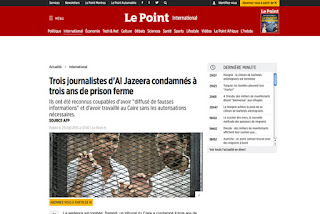
Le Point - France

Mashable - USA

NDTV - India

New York Times - USA

Nieuwsblad - Belgium

NRC - Netherlands

Powned - Netherlands

skyNews - Britain

Spiegel online - Germany

Sydney Morning Herald - Australia

tagesschau (TV 1) - Germany

The Indian Express - India

The Irish Times - Ireland

The Times - Britain

The Times of Israel - Israel

The Toronto Star - Canada

Wall Street Journal - USA

Yahoo news - USA

Your Middle East - Sweden

Die ZEIT - Germany


And there's lots more in print.

In trying to silence reporting by three journalists, Egypt has evoked for over 20 months now a constant reporting by hundreds of media outlets the world over. If anything has damaged the reputation of Egypt, the stubborn ruthlessness by the regime to attack a free press and individual journalists has.

A shot-in-foot story if ever there was one. And unless the regime of President Sisi finally gets this, the reporting and subsequently damaging of Egypt's reputation will continue. Worldwide. For as long as such attacks continue and definitely until the journalists Mohamed Fahmy and Baher Mohamed, criminally held in jail now, are set free and allowed to return to their families.

Not to mention the dozens of other journalists held without charges in Egypt's detention hell holes, in violation of Egyptian law and even the Egyptian constitution.

Journalism is not a crime, Mr President Sisi. – Suppressing journalism is.


January 31, 2014

How the Harper government fails Canadian journalist in Egyptian jail

On December 29, 2013, three journalists working for Al Jazeera English channel in Egypt – the Cairo Bureau Chief Mohamed Fahmy, a Canadian-Egyptian, Peter Greste, a renowned Australian journalist, and the Egyptian producer Baher Mohamed – were arrested in their rooms of the Marriott Hotel in Cairo, their equipment was confiscated, and they were taken to the high security prison Tora, were high-profile leaders of the Muslim Brotherhood, declared by the Egyptian government to be 'terrorists', are currently held.

For weeks no charges were laid against these journalists and Egypt refused to give any legal explanation. The Cairo Bureau Chief Fahmy was reportedly treated the worst of the three detained. While all had to suffer under solitary confinement, Fahmy got a 'special' treatment by not being allowed medical treatment for a broken shoulder and having to sleep on the cold cement floor in a cockroach-infested cell with no daylight.

On the anniversary of the Egyptian revolution, January 25, 2014, almost a month after the arrest, the treatment got even worse: the prison guards took away his watch, his jacket and the only blanket he had for sleeping on the floor. Medical treatment to his broken shoulder, four weeks into the injury, was further denied. For over 20 hours he was denied food and to go to the bathroom. The guards explained this treatment as a 'punishment' for a bomb attack the day before in Cairo – to which the journalist Fahmy in his solitary confinement plainly and clearly could not have had any connection.

On January 29, the Public Prosecutor of Egypt suddenly came up with charges against 20 Al Jazeera journalists, amongst them the three detained at Tora. Widely broadcasted on Egyptian State TV under the banner "Fight against terrorism" the prosecution accused the journalists to have supported a terrorist group (aka the Muslim Brotherhood) by inventing false news about the situation in Egypt, thus shaming Egypt in the world and 'harming national security'. Fahmy was in addition accused of being a member of the Brotherhood (which he is not) and charged to be a 'terrorist'.

International demands to set them free

Accusing and charging a Canadian-Egyptian journalist to be a terrorist just for interviewing members of a political group or reporting on clashes between the state security and this group was a harsh attack on the freedom of media in Egypt and seen by many as a deliberate warning sign to other foreign journalists to not report the truth about the unrest situation in the country.

On January 13, more than 40 editors and correspondents from international media organisations signed an open letter to the Egyptian government demanding the release of the journalists. Many international NGOs like amnesty international, the Committee for the Protection of Journalists or Reporters Without Borders protested against the treatment of the Al Jazeera journalists and especially those detained under the extreme conditions in Tora and demanded for the charges to be dropped immediately and the journalists to be freed. Amnesty international adopted Mohamed Fahmy, Peter Greste and Baher Mohamed as 'prisoners of conscience', imprisoned solely for the peaceful exercise of their right to free expression.

As Fahmy was treated the worst in prison, punished for things he clearly could not have any doing in and kept without medical treatment for a broken shoulder for four weeks – violating a prisoner like this is breaching international and Egyptian laws and called torture – it was expected that the Canadian government would issue some statement, expressing at least concern over the abhorrent treatment of a Canadian citizen and journalist. Yet, the only thing that came out of Ottawa (and only on demand) was a diplomatic thin-lipped wording saying that 'consular services' were provided and that officials had 'raised this case with senior Egyptian officials'. Something that the family of detained Fahmy could not confirm for weeks, as Fahmy repeatedly was dragged to interrogations without any representative of the Canadian embassy being present.

Contacting the Harper Government

Shortly after the prosecutor had finally let the cat out of the bag that the journalists were considered to be supporters or, in the case of Fahmy, even members of a terrorist group, I wanted to know from the Harper government in Canada their position expressively on the plight of their Canadian citizen Fahmy. The only statement by Canada issued before was empty of any reliable acknowledgement of his situation or the willingness to speak out in his favour.

I contacted the Canadian Departement of Foreign Affairs and spoke to Jean-Bruno Villeneuve, who is the spokesperson for Minister of Foreign Affairs, John Baird, regarding 'Middle East' and 'Human Rights and Democracy'.

When I asked about the position of the Canadian government on the fact that a Canadian citizen and journalist had now been kept in a dark cell without treatment for a broken shoulder for four weeks, Baird's spokesperson read to me the earlier published statement:
“Consular services are being provided to the Canadian citizen who has been arrested in Egypt.
Officials are in regular communication with and providing assistance to those family members that the subject has provided authorization to speak with.
Canadian officials have raised this case with senior Egyptian officials and local authorities continue to be engaged."

M:    Well, that I know already, it is not new. But that does not say anything.

V:    What I have provided is really the extent of what we have to say on this issue.

M:    Today things have escalated, as you are aware, due to the fact that charges are now being laid against all those who have been implicated in this, including the Canadian. There must be more from the Canadian government with regard to a political stance on this, because this is an attack on press freedom which in Canada is actually very protected?

V:    Yes, well Mr. Moremi, as I said, that is the extent of what I have to provide at this stage. But don't hesitate to be in touch with us tomorrow and in the coming days and hopefully we have more to say on this, but today that is the extent of the statement I can provide.

M:    But that would be a bit odd to tell the world that that is all Canada has to say if a Canadian citizen and journalist is detained under such circumstances. I would just like to point out that US Senator Cain on the weekend has spoken up and demanded from Egypt to free these journalists, and there is not even an American citizen or journalist involved. And the world is still waiting on something clear from Canada, because as you well know your Canadian citizen has now been in jail exactly for a whole month. So I would not be quite sure, what would be different tomorrow?

V:    Ok, well I'm not going to comment on what other countries have said. But I have given you the extent of the Canadian statement on this issue at this stage and I'll make sure to be in touch and don't hesitate to be in touch with us as well.

M:    Mr. Villeneuve, the colleague who is currently incarcerated in Cairo is incarcerated under conditions that both Canada and other countries, even under the laws of Egypt, are clearly seeing as a violation of human rights. He is not getting medical treatment and your talking to officials is not helping him. He has a broken shoulder, he has not been attended to for four weeks. It was supposed to be attended to on Sunday. Again it has not. The only blanket he has has been taken away from him. If you research what a broken shoulder means if it's not tended to that should trouble the Canadian government immensely. So this surely can't be the only thing Canada has to say to this? You spoke up for John Greyson and Tarek Loubani, why the silence on Mohamed Fahmy?

V:    Again - consular services are being provided and the statement is all we have to say at this stage.

M:    Does that mean that the Canadian government is not willing to say anything with regard to the fact that a Canadian citizen has now for four weeks been in jail with a broken shoulder and without any medical treatment?

V:    I gave you my opinion on this ...

M:    No, I'm asking you. You're not even mentioning the shoulder that is broken, I mean, just imagine you would be in jail with a broken shoulder for a whole month and your government would not even say something to that. Why is that so? The world does not understand it. No one understands why Canada on this is the only country that does not say anything. Why don't you at least demand that he is treated like a prisoner should be treated according to international treaties that are also valid for Canada?

V:    I cannot comment on personal and private information, as is the case, as you can appreciate ...

M:    No, I can't appreciate it because this is not a 'private' information if a Canadian citizen for a whole month now has been in an Egyptian jail with a broken shoulder and no medical treatment, that is not a private information. This is a human rights violation of a Canadian citizen and the world is asking why Canada's government is not saying anything on this?
Are you demanding from the Egyptian government to at least give him the rights that a prisoner in Canada and everywhere else in the civilised world has? Is this a demand the Canadian government makes or not?

V:    Ok – "Canadian officials have raised this case with senior Egyptian officials and will continue to be engaged with local authorities" – and that's all I have to say on this at this stage.

M:    But you are aware that even if you have spoken to officials this has not bettered his situation but it has made it worse after a whole month? I mean, how long does the Canadian government think a person can survive with a broken shoulder in solitary confinement lying on a floor with not even a blanket?

V:    I really ... I really have provided all I have to say on this ... And I'll make sure we'll be in touch with you when we have more to say, thank you ...

M:    So that means the Canadian government is not saying anything on the lack of medical treatment of a Canadian journalist in an Egyptian jail, is this correct?

V:    I will send you the Canadian statement ...

M:    Yes, the Canadian statement I know. You're not saying anything about this in the statement. I'm asking you, is the Canadian government not saying anything with regard to the fact that a Canadian journalist is subjected to something that is called 'human rights violation'?

V:    (hesitates) Well ... I'm the spokesperson for this issue and I'm providing you with our statement. Thank you very much.

M:    Well, you know I'm not satisfied. – And you know I can only then report that the Canadian government ignores the fact that a Canadian journalist is lying in a jail cell with a broken shoulder. – And there is nothing you say to this?

V:     Sir ... I have ... I have given you the extent of what I have to say at this stage, but I'll be in touch, ok ...

M:    We are both professionals. I have been working in this profession for 35 years. You are trying to ward me off. But this man has been under these conditions for a whole month now. When is the Canadian government, that was able to say something on John Greyson and Tarek Loubani, willing to say something against the human rights violations of a Canadian journalist? This is a very simple question. And you can only answer that with saying the Canadian government does not care and will not say anything to that or you can give me any reaction of the Canadian government.

V:    Ok, a) I didn't say that ...

M:    No, you didn't. But then, what do you say?

V:    Well, I provided you with our statement, Sir.

M:    But in your statement it doesn't say anything about the fact that this man has now been subjected to human rights violations for four weeks! The man has a broken shoulder! Surely the Canadian government is absolutely aware of the fact that a broken shoulder needs medical treatment? No prisoner in this world – and this is Canadian law – may be subjected to this treatment not getting medical treatment for four weeks! So surely, if this happens to a Canadian citizen, the Canadian government must have something to say to this other than "we're not saying anything"?

V:    (pause) I really ... I really have nothing further to add ... So, I'm gonna hang up now. And I'm going to send you the statement by email. And ... I'm sorry it is not satisfying you. I can appreciate why ... But ... that's the extent of what I have to say at this stage. Thank you.

M:    Seeing the fact that this has now been going on for four weeks, is there any idea on your part that the Canadian government will come up with something more than just this statement in the future?

V:    (long pause) I don't have any such information on this at this stage. But if, why and when we do I will make sure we'll be in touch, ok? Thank you very much ...

M:    And you can also not explain why you said something on John Greyson and Tarek Loubani? John Baird said something there.

V:    Ah ... I provided you with our statement on this, Sir, and now I'm gonna hang up, ok? Thank you very much ... (waits) ... Good day ...

(Hangs up.)


Australia's Foreign Minister acts

At the same time that I was having this rather amazing conversation with the spokesperson of the Canadian Foreign Minister, as I learned later when contacting Canberra, in far away Australia the Minister for Foreign Affairs, Julie Bishop, was alarmed at learning of the charges now made public.

She had summoned the Egyptian Ambassador into the Foreign Office on January 16 and asked that a meeting would be arranged between the Australian Ambassador in Cairo and the Public Prosecutor to discuss the fate of Australian journalist Peter Greste. This was promised, but nothing had happened. When on January 29 instead the Public Prosecutor announced charges against Greste for supporting a terrorist group, Australian Minister Julie Bishop picked up the phone and called her Egyptian counterpart, Foreign Minister Nabil Fahmy.

In an interview with the Australian Broadcasting System she explained, that this had been a "very candid" discussion with Fahmy and that she had raised her serious concerns on this matter and on the abhorrent prison conditions Greste was subjected too. Apparently the Egyptian Foreign Minister was willing to accept her protest and assured her to do anything in his power to be of help.

A day later, last night, a meeting between the Australian Ambassador in Cairo and the Egyptian Public Prosecutor finally did indeed come about and the Australian government for the first time was officially informed on the exact charges laid against their citizen Greste. The charges, as Bishop points out, are now under legal review by the Australian government, and she made it very clear, that she will keep engaging for Peter Greste to try to ensure he receives both due process and from now on humane prison conditions. 


The U.S. State Department is "alarmed"

Shortly after my conversation with Canada's Foreign Ministry spokesperson and Australia's Foreign Minister Bishop's conversation with her Egyptian counterpart, the U.S. State Department's spokesperson Jen Psaki commented in unusually strong words on the attacks against the Al Jazeera journalists in Egypt. Even though no American journalist was implicated in the case, the Obama administration found it important enough to publicly criticise what was happening to press freedom under the military rulers of Egypt and said:
"The government’s targeting of journalists and others on spurious claims is wrong and demonstrates an egregious disregard for the protection of basic rights and freedoms."

Psaki added that the U.S. was
"alarmed by reports today of additional journalists facing charges, including the Al Jazeera journalists. Any journalist, regardless of affiliation, must not be targets of violence, intimidation, or politicized legal action. They must be protected and permitted to freely do their jobs in Egypt. We remind the Egyptian Government publicly and privately that freedom of the press is a cornerstone of democracy and we urge the interim government to implement its commitment to this freedom. We strongly urge the government to reconsider detaining and trying these journalists, and reiterate that they must be afforded all accordance of the due process under the rule of law."

Another attempt in Canada

The next day, January 30, I found it vital to confront the Canadian Foreign Ministry with this very outspoken and clear critical statement of the U.S. government regarding the attacks against journalists in Egypt.

When the sun was up in Ottawa yesterday, mid-noon Cairo time, I contacted the spokesperson of Minister Baird once more, send him the clear worded statement of the U.S. State Department, expressing "alarm", and asked:
"How alarmed is the Canadian government in the light that a Canadian journalist is among those wrongly targeted?"

It took a while for a response. Late in the afternoon Villeneuve in a friendly but slim-lined reply once more send me the known statement regarding consular services and this time added the line:
"To protect the privacy of the individual concerned, further details cannot be released at this time."

This was both unsatisfactory as nonsensical, as I pointed out in my return mail:
"In how far does the protest of a country (Canada) over an attack on press freedom (compare US State Dept. statement) have anything to do with "privacy of the individual concerned"?

The question was if Canada is as "alarmed" on the "targeting of journalists" in Egypt and considers this too a "disregard for the protection of basic rights and freedoms"?

This has nothing to do with privacy issues.

Is there a political position of the Canadian government on this or not?"

The sun had already set over Tora prison in Cairo last night when the reply from Baird's spokesperson finally arrived. It read:
"Hi Jon,

I don't have anything to add to what I provided you with.

Thank you.

JB"


UK Foreign Secretary raised his concerns

In the meantime, the British Foreign Office in London today has supplied me with a statement saying that they are aware of the situation that two British journalists have also been charged with supporting terrorism and they are seeking further information from the Egyptian authorities. The statement went on to say:
“We were concerned by the closure of political space for opposition groups in the run-up to the referendum and the arrest and sentencing of human rights activists. We are also concerned by continuing restrictions on freedom of expression and the press. The Foreign Secretary raised these concerns in a conversation with Egyptian Foreign Minister Fahmy on 7 January.”

Apparently only Australia, the UK and the U.S. seem to find fault with the attack on press freedom and journalists in Egypt. While all three governments voiced their concern both in public expression and direct contact with the Egyptian Foreign Minister Fahmy – in Canada, whose citizen and journalist Mohamed Fahmy has languished under inhumane and torturous conditions for more than four weeks now in a dark cell with being refused medical treatment for his broken shoulder, Minister for Foreign Affairs, John Baird, still does not seem to see any reason to pick up a phone.

It is at this point that I know that I could never be tempted to become a Canadian citizen.

For only a country in need, is a country indeed.


-----------


The UN High Commissioner for Human Rights in Geneva has issued a statement today saying the UNOHCHR is
"extremely concerned about the increasingly severe clampdown and physical attacks on media in Egypt."

Pointing to a deterioration in the last months the statement continues:

"Wednesday’s announcement that the Egyptian Prosecutor-General intends to bring to trial 16 local and 4 foreign journalists alleged to have worked for the international broadcaster Al Jazeera, on vague charges including “aiding a terrorist group” and “harming the national interest”, is of great concern. ... There are also reports of journalists in detention being subjected to ill-treatment or being held in conditions that are not in line with international human rights standards. 

We urge the Egyptian authorities to promptly release all journalists imprisoned for carrying out legitimate news reporting activities in exercise of their fundamental human rights. It is the State’s obligation to ensure that the right to freedom of expression is respected, and that journalists are able to report on diverse views and issues surrounding the current situation in Egypt."


October 08, 2011

Britian and Germany demand release of blogger Maikel Nabil

Both the British and the German government have demanded from the Egyptian Supreme Council of Armed Forces (SCAF) the immediate release of blogger Maikel Nabil who has been on hunger strike for more than 40 days and is in serious danger of dying.

Nabil was arrested on March 28 and sentenced in absentia of both him and his lawyers to 3 years in prison for 'insulting the army' with a critical blogpost. He had truthfully reported on countless human rights abuses by the armed forces against unarmed protesters after the January 25 revolution. Nothing he wrote was not known and published on the internet before, but since Maikel Nabil had refused military service last year the army obviously wanted to get revenge. A gross violation of the principles of the Egyptian revolution that the SCAF pretends to protect and support.

On 4 October an appeal from Maikel Nabil's lawyers was to be heard in military court in Cairo. But although it was known that Nabil was in the state of dying from the hunger strike the session was adjourned by the military judge because files he needed had not been laid on his table by the administrative clerks of the court. Something neither Maikel Nabil nor his lawyers could be held accountable for. Already an unbelievable shame that such poor preparation of a vital court session was allowed to happen it was an ever bigger shame if not to say a crime to postpone the court session because of this in knowing that Maikel Nabil could die any day.

Both the British and German government have now urgently called on the Egyptian SCAF to release Maikel Nabil and allow him a fair trial in front of a civilian court, to which he is entitled.

Foreign Office Minister Alistair Burt MP said:

"I have serious concerns about the treatment of Maikel Nabil Sanad, an Egyptian blogger sentenced to three years imprisonment on 10 April by an Egyptian military court. Maikel Nabil Sanad has been on hunger strike since late August and his health is now deteriorating.

"We have raised concerns about Maikel Nabil Sanad’s treatment as well as the issue of trials of civilians in military courts and the continued State of Emergency with the Egyptian authorities. We continue to urge the Egyptian authorities to repeal the emergency law.

"Freedom of expression, including freedom of the media, is fundamental to building a democratic society and we will continue to follow the human rights situation in Egypt closely."


The spokesperson on human rights for the German government, Markus Löning, said:

"The news of the live endangering condition of jailed Egyptian blogger Maikel Nabil Sanad is seriously disturbing. In the name of the Federal Government I urge the authorities to suspend the jail sentence of Maikel Nabil immediately and to let a civilian court in a fair trial review the verdict handed down on 10 April by the military tribunal.
The large number of trials against protesters and activists in military tribunals is alarming and is not in accordance with the rule of law.
The Egyptians went to the streets to fight for dignity and democracy. All authorities are called upon to respect this and to do everything in their power to promote Egypt reaching its goal of a true democracy."

Amnesty international, Human Rights Watch and Reporters Without Borders have continuously called for the release of Maikel Nabil and have pointed out that the Egyptian SCAF carries the whole responsibility should Maikel Nabil Sanad die in prison from hunger strike. The SCAF so far has refrained from reacting to the worldwide appeals to stop this gross violation of human rights.

With the continued revenge they take on the blogger they once more prove that the principles of the Egyptian revolution, for which 850 Egyptians gave their life, obviously mean nothing to them. The US must seriously reconsider funding such human rights abuses annually with the amount of 1.3 billion Dollars  in military aid to a SCAF that clearly does not respect international humanitarian law.

-----------

September 14, 2011

ساعد فى تحرير مايكل نبيل - الأمر أسهل من ما تتصور

مايكل نبيل مضرب عن الطعام منذ 23 أغسطس وأكمل الإضراب بإضراب عن الماء والدواء لمدة أسبوع بدءا من 30 أغسطس، وأنهى إضرابه عن الماء بعض إصابته بمغص كلوى ولم ينهيه عن الدواء وسيضرب عن الماء مجددا يوم 9 أغسطس تضامنا مع الدعوة للتظاهر.
لم يستطع أهله مقابلته، وقد دخل فى غيبوبة ثم دخل مستشفى السجن، وبعد ذلك أخرجوه من المستشفى.
حياة مايكل فى خطر. فقط القوة العظيمة للمتفهمين لمدى قوة التضامن فى بحر مئات آلاف المساهمات تستطيع إنفاذه.

أرجوكم تصرفوا الآن! الأمر أسهل من ما تتصوروا.

بحسب الإجراءات العاجلة لمنظمة العفو الدولية ومطالب مراسلون بلا حدود وهيومن رايتس ووتش ولجنة حماية الصحفيين, تستطيع كتابة 5 رسائل سهلة لأشخاص داخل مصر الذين يستطيعوا فعل تأثير على إذا ما كان مايكل نبيل سيتم إطلاق سراحه أم لا. كل النصوص التى تريدها موجودة بالفعل. كل ما عليك فعله هو نسخها فى ملف وورد أو برنامج للإيميل وإرسالها.

إنقاذ الحياة لن يكون أسهل من ذلك. تأكيدا على أنكم لا تتسامحون مع الحكم على حرية التعبير فى مصر الجديدة بعد الثورة التى تعتبر حيوية بكل رئيسى.

أرجوكم تصرفوا الآن لمساعدة مايكل نبيل على التحرر قبل أن تسوء حالته الصحية أكتر بكثير وربما يعانى من إصابات بالغة وممكن أن يموت.


------------------

September 04, 2011

Help free Maikel Nabil - it's easier than you think

Many years ago amnesty international had a slogan on their banners that read:

"100.000 persons think: One person alone can't make a difference."

100.000 persons thinking that - will achieve nothing - while 100.000 persons understanding they are an impressive force - will achieve a lot.

In the case of the imprisoned blogger Maikel Nabil this force can decide over life or death. Because Maikel has been on hunger strike for almost two weeks now - and on thirst strike for six days. Three days ago he went into a coma and was transferred to the prison hospital. His family is not allowed to see him, no one is getting information about his health and what exactly they are doing to him in the prison hospital. Maikel's life is in danger and only the massive force of many understanding how powerful their one contribution in a sea of hundreds of thousand contributions is, can save him.

Please take action now! It is much easier than you think.

In accordance with the Urgent Action by amnesty international, the demands of Reporters Without Borders, the Human Rights Watch and the Committee to Protect Journalists - you can write five easy letters to the person's in Egypt that can make an impact on whether Maikel Nabil is set free or not. All texts you need are there already. All you need to do is copy them into your word doc or mail program and send them off.

Saving a life couldn't be easier. Making a point, that you do not tolerate the sentencing of freedom of opinion in the New Egypt after the revolution couldn't be more vital!

Please act now to help get Maikel Nabil free before his health deteriorates even more and he might suffer serious injuries or possible death.

Here you find the texts you need for your action.

August 23, 2011

Egyptian blogger Nabil jailed by army starts hunger strike

On March 28 at night the army arrested blogger Maikel Nabil for blogging about the army and documenting the atrocities against peaceful protesters. Two weeks later and against all international appeals and outcries Nabil was sentenced to three years imprisonment with hard labor and a fine of 200 L.E. for "offending the army". No appeal by human rights groups or even the U.S. government - a firm ally of the Egyptian army - could alter this and he was immediately transferred to prison.

Human Rights Watch called the sentence
"the worst strike against free expression in Egypt since the Mubarak government jailed the first blogger for four years in 2007".
Yet the SCAF found no fault with this, sending a clear signal that it couldn't care less about freedom of expression in Egypt. Amazing, as it is the same SCAF that put up a Constitutional Referendum to vote on, containing explicitly freedom of expression and opinion. In a press conference with General Mamdouh Shaheen and General Ismail Etman it was pointed out that the Constitutional Interim Declaration that resulted from the referendum prevents arrests or detentions without legal basis and ensures freedom of the press as well as freedom of belief and opinion.

Does the SCAF not read its own declaration? How then fits the arrest and sentencing of a blogger into their own declaration? - The SCAF doesn't answer.

On April 8, U.S. Senator Mark Kirk and Member of Congress Frank Wolf wrote personally to Field Marshal Tantawi, Chairman of the Supreme Council of the Armed Forces, asking him not to sentence Nabil but set him free.

Despite this letter from the U.S. Senator and the Congressman, Maikel Nabil was sentenced only two days later to a prison term of 3 years - and - which is even more astounding - in a secretive way behind the backs of his lawyers and in violation of legal procedures while he was not in court. He has been in jail ever since.

Design by Kirolos Nagy / @Kiroz_

Strong protests show now reaction from SCAF

"The sentence is not only severe, but it was imposed by a military tribunal after an unfair trial", said Joe Stork from Human Rights Watch. And Sarah Leah Whitson, Middle East and North Africa director at HRW warned: "This trial sets a dangerous precedent at a time when Egypt is trying to transition away from the abuses of the Mubarak era."

Reporters Without Borders were shocked at the sentencing of Maikel Nabil: "The circumstances of this blogger’s arrest and the conduct of his trial demonstrate a complete lack of consideration by the military for the most basic principles of international law."

But the Generals of the Army are unwilling to abide by such laws. To them criticism of the army is a crime that must be punished. Since Maikel Nabil's arrest and conviction several journalists, bloggers, twitter and facebook users have come under surveillance, have been summoned to the military prosecutor and threatened with military trials. Strong protests from activists in Egypt and abroad have so far managed to stop the military going through with their crackdown. But all the national and international outcries over the blogger's sentence have so far shown no reaction from the SCAF.

Now Maikel Nabil has started a hunger strike today protesting against his treatment and the attack against freedom of opinion that is guaranteed in a Constitutional Interim Declaration the SCAF itself is not willing to respect. The hope remains that this time more activists will show solidarity with Nabil hopefully having understood by now that when one blogger is thrown in jail, others may soon follow. It could be them - it could be us - it could be you - tomorrow.

Design by Kirolos Nagy / @Kiroz_