February 14, 2014

The legacy of Reeva Steenkamp

Today, a year ago, on what the world calls Valentine's day, the day of love, a beautiful woman in South Africa lost her life. The beauty she held is documented not only in the good looks the world talked about, but in what she said and wrote and what family and friends recount in loving memory. Reeva Steenkamp to many was the model, the TV personality-to-be, the girlfriend of the so called blade-runner, Oscar Pistorius. In November 2012 she had first appeared publicly at his side and her words to the camera about him where carefully chosen, as makes sense at the beginning of a new relationship. After all, Reeva, whose strikingly warmhearted smile had become a trademark, had not only positive experiences in what is deemed love. She had suffered for years in an abusive relationship and had come to Johannesburg to reshape her life.

On Valentine's day 2013, barely four months after the relation had started, Reeva wanted to make the day special for her new boyfriend and for herself. But as she was not only about herself, as some might have thought, Reeva had also intended to make this a day for others, to speak about her struggle against life's odds and domestic violence to pupils at the Sandown High School in Johannesburg. She wanted to be honest about the abuse she knew and encouraging to young people and especially girls to become proud adults who would not ever be humiliated by anyone, let alone by male violence.

She never got to speak at Sandown. While staying the night at her boyfriends house she was shot dead by him shortly after 3 am in the morning, locked in a toilet cubicle where four bullets that her boyfriend shot at the door took her life.

Much has been written about this fatal moment, about how or why Oscar Pistorius drew the gun on her, on whether, as he states, this was an accident, or as the state prosecution in the charges say it was murder. The trial is set to begin on March 3. And no matter what is written or said, the answer to this will only – hopefully – come to light in the hearings. To the family and friends who loved her dearly it will be the hardest time to endure after 13 months of feeling the loss.

The woman who cared for victims of domestic violence

Reeva Steenkamp was blessed by nature with looks which made it to the cover of magazines and she knew how to strike a good pose. She was starting to develop a promising career as a model and her smile and blonde hair made everyone believe that this was what she was all about: modelling, beauty, the feminine touch. Few knew that the woman behind the poses was a hard working law-graduate about to engage in her Bar exam. With 30, a birthday to come up in August last year, she wanted to have reached her goal of being a qualified legal advocate defending the rights of those who couldn't defend themselves.

When in the Cape Province 17-year old Anene Booysen was brutally gang-raped and slashed to death by her rapists and on February 9, 2013, the teenager was laid to rest, it was Reeva who remembered her on her twitter account:


she wrote, ignoring that such a topic was not the in-thing to care for in a world of glamour and bright lights.

But the model who was the star of scene parties and always a good shot for high-key photography didn't keep in those circles in her mind. While she was fashionable and for many simply a symbol of good looks, there was a serious thinking person behind the cover the others wanted to see only. Her troubling experiences in her own relationship many years ago had made her lose her self-worth heavily. She did a lot of soul searching to remind herself of her value in the world, started to get back on her feet and work hard in a business formerly unknown to her, and while her fame rose and the offers came rolling in more and more, she never forgot that there was more to life than just good looks, fashion and partying. There was a message for the students at Sandown High that she spelled out in writing, but never got to tell them in person:
"Be brave. Always see the positive. Make your voice heard. Your physical seen. And the presence of your mental you felt. It's that culmination of your person that will leave a legacy and uplift."

A day after the funeral of Anene Booysen, on February 10, Reeva Steenkamp, once more ignoring who her followers could be on social media, wrote on her instagram account:


Little could she know that only four days later she herself would fall victim to male violence and the comfort of the happy safe home was exchanged for death.

“Reeva held a passion for women’s abuse issues and frequently spoke out against domestic violence. She intended to one day open an establishment where abused women would be cared for", her parents said in a statement a few days ago. Once the trial is over they intend to start a foundation "honouring Reeva’s passions”.


The trial is about truth and justice

After the funeral - candles in the sky
For those who loved her the trial is both a promise that the terrible time of uncertainty about what exactly happened that fateful night at Pistorius' house will finally come to an end, as well as the hope to find closure in a loss that one way or the other will stay with them for the rest of their lives. It will be a troubling time of battling emotions, and the press will take any chance to show a crying mother or a bereaved friend. That Reeva was killed is no news to them anymore. It has been reported numerous times now and fails to capture the imagination of editors who want new points of interest to catch their readers and viewers. And while to the family and friends of Reeva Steenkamp the trial will be all about her, the burning pain of having lost her and the love they forever hold for her, others will see it only as a chance to get headlines and news stories to serve a never ending hunger. It is, sadly, the way the media world works.

And yet – thinking of Reeva Steenkamp and the compassion she held for others, the hope goes out that just this time the media will tread softly and value the pain over a loss that to this day for many cannot be understood. They want this trial to happen, yes. But they don't want the frenzy that will go with it. For the family and friends this trial is about truth, about knowledge and about justice served for a woman whose smile and heart went out to so many and could have still done so much good, had her life not been cut short.

Those who loved her will do so long after the trial is over and the flashlights have found new objects of interest. Getting through it is a tribulation they endure for her and for her only. The intimacy of grief they still posses to this day is theirs, and it gives way to a vulnerability that should never be exploited. The world and the media must respect this at all costs and thus honour the legacy of Reeva Steenkamp.

The woman who showed compassion for Anene Booysen while others only wanted to see glamour deserves nothing less.


February 03, 2014

Letter to my Avatar – My dear little Omar Salah ...


one year ago to this day you were selling sweet potatoes on a street in Cairo near the U.S. embassy. It was not something you did out of choice, but because your family is poor and needs you to help secure an income. There was nothing special about this February 3rd, 2013, Cairo was calm and sunny, and nothing prepared you, when you left your home in the morning, for what was to come.

It was about noon, when a soldier came up to your cart and demanded from you to sell him two potatoes. You urgently needed to go to the bathroom at that moment and told him you would attend to him right when you would be back. The soldier did not accept this and threatened you with his gun saying he was going to shoot you if you didn't serve him immediately.

You were just a 12 year old boy. What could you know about the defects of human minds or the willingness of adults to be vicious? You did not believe him and in the innocent mind that was your right to have with 12 years of age you replied: "But you can't shoot me!"

To this the soldier replied: "I can't?" And then he pulled the trigger and shot you twice in your little heart. You were dead immediately.

The shock this had on those who witnessed it around you, was profound. The other children street vendors cried out and emotions ran high while your blood was spilling onto the street of Cairo. Amongst the soldiers, heated discussions started and the whole situation quickly became a mess.

The U.S. embassy tweeted that there had been an 'incident' in front of their gates but gave no details. For quite some time no one was aware what horror had just happened under the sunny sky of Egypt. And with the first shock subsiding that you indeed were dead right there on the street and for all to see, the military and police started frantically to do anything they could to cover up this horrific crime against you.

While your mother and father sat at home unaware they had lost you forever, the army took your little body to a morgue and covered you hoping that no one would find you and no one would find out. For accepting that one of theirs had killed you in cold blood and take responsibility for this action is not on the mind of the army of Egypt.

You must know, little Omar, that you are not the only one they killed, and not the only one they did not care for after he was dead. Over a year before you left us they had shot dead many protesters at Maspero and ran others over with heavy APCs. Again, later, they killed many at the Cabinet clashes. And so it goes on and on until today, for killing someone is the job of an army, they think. And they don't differentiate between borders or cities, it doesn't matter where they use their guns, they always think that they are in the right to kill. For no other but them has any right to a life. Only a right to be disrespected when – in the eyes of the army – the situation calls for it.

Of course, on that day one year ago, your killing had nothing to do with defending anybody. The soldier who killed you did not feel threatened or feared for the safety of Egypt. He simply expressed what he had learned as a conscript: that you as an Egyptian human being were not worth anything and that your life was cheap enough to be destroyed.

After your father had frantically tried to find you, aided by friends and NGO workers, your little blood stained body was finally found in the morgue. At first again the army tried to deny it had anything to do with this. But as pressure mounted and more and more witnesses spoke up to what they saw that day, the spokesperson felt it would hurt the army more to stay cowardly quiet than to come out with it and he put a statement on their Facebook page declaring your death an "accident" for which he offered your heartbroken parents his "apology".

The story goes that the soldier did not really mean to shoot you. He had thought that his gun was empty – because apparently Egyptian soldiers don't learn how to find out if their gun is loaded or empty and never load them themselves. It must be some hidden force that either loads their guns or not and then falls silent on the matter so that a soldier who carries his gun through Cairo is never aware whether he can actually use it or not. It seems an odd way to run an army or a disturbing way they play games, but then, my little Omar, there are so many odd things surrounding them that one does not wonder much anymore these days. Of course, after the soldier fired the first shot into your heart realising the gun was loaded after all, he had to fire a second time into your heart just to make sure he wasn't mistaken. That we understand. The army is a responsible body and what must be done must be done to make certain that facts are facts. Even in accidents.

Shortly after the world learned what had happened to you on that wonderful sunny February day in Cairo, a video surfaced on YouTube showing you only a few weeks earlier when you were interviewed on the street by an organisation helping needy children, checking whether you might be eligible for their projects.

You were humble and well-mannered but a little shy and uneasy what they would come up with and whether you would be good enough for what they were looking for in you. You told them quietly that you had to sell sweet potatoes because your family was poor and your father had wanted you to support the family. And in all shyness you disclosed into the camera that you would love to go to school and learn to read and write.

When the interviewer asked what you're dreams were, you looked away and were uneasy on this. And then you answered him. You said: "I cannot afford dreams, Sir." And you looked into the camera and then down again as if you were ashamed for this that was none of your fault.

Seeing this video of you, dear little Omar, broke many peoples heart. Hearing that you could not afford to dream, which is a basic human right for a child, and knowing you were not even allowed to live, was unbearable to witness. Seeing your wonderful eyes, your look of modesty, shyness and subdued hope, your life might one day, just might perhaps change for the better in some far-away future after all, teared us apart. It was then that I took your picture and made it my avatar on twitter. I wanted to give you your face back that had been left so sad and soiled and empty of life after the soldier had shot you dead.

There was no justice for you after all this. On public pressure of human rights activists and your family that the army tried to silence with money, a military trial was finally staged that we all never had any witnessing to. Only afterwards we were told that the soldier who shot you dead – just like that, on a sunny day in a street of Cairo – received a sentence of three years by the military judge.

Imagine that, Omar, three years for killing you and destroying your life forever. Do you know that Ahmed Maher and Mohamed Adel, activists of the January 25 revolution, got just the same sentence of three years for allegedly staging a protest without a permission? So killing you, in the eyes of the army, apparently was not worse than going out to protest without requesting a permit. You see what I mean when I say, we do not understand the ways of the army, but we trust they know well what they do?

One year on, my dear little Omar, I have thought long and deep over whether I would let you rest now in your little grave and put a shroud over your wonderful eyes that I see everyday on my twitter timeline. On twitter people have not a very long attention span, you must know. They easily get bored seeing the same avatar over and over for months and need changes a lot to be easy. And many times when I write critical tweets, some tweeps who do not know me or you come and slam me with words like: "Shut up, kid" – actually thinking, I was you and not a grown up man with 35 years working experience. They don't take my words seriously, because – just like the soldier – they think, a young boy has no value and no meaning and must not be respected. l cringe sometimes when I read their "kid", knowing they mean you, and feel the pain of your death they are unaware of and don't understand, and then I tell them to read my profile and come to the conclusion that whoever has no heart for you in his reaction is not worth thinking about anyway. And leave it at that.

It would be so much easier now to let you rest, my little friend, after this long year of tears and pains and death that has sweeped Egypt empty of so many hopes for a decent life, for justice and freedom and bread. On twitter they would jubilate to see a fresh face. The army would love to not have to see you anymore in the public sphere. The tweeps I criticise would not be able to slam me anymore with calling me 'kid'. We would all be so much happier, dear little Omar, if we forgot about what happened a year ago and that we can't change what happened to you after all.

But then, Omar, what can we change if we don't remember? What possibilities will we manage to create if we fall silent and look away and pretend it is all not as sad, not as bad, not as tragic as it actually is? Since your death more than a thousand Egyptians were killed, and they give us many reasons why that, different to you, was not an accident but needed to happen. But apparently they can 'live' with it just as easily. A strange tale has crept into the narrative that pretends that destroying Egyptian lives is inevitable and must be accepted, as if death more than life was the natural thing of the world that one can shrug off to return to the daily pleasures and chores. With every death of human beings falling bloodied in the streets of Egypt we are told to believe that nothing of this can be changed because it is the way of the world. And when we look away and shut our ears to the cries of the mothers and fathers of Egypt who, whether they agreed with their children or not, break down over losing what was precious to them forever and think they just cannot go on anymore, we change the world for the worst, where dying becomes the natural thing and living is just a luxury granted by some in power – whether we are lucky or not.

It must not be luck, little Omar, whether we live. It must be a right, a birth given right that no one must be allowed to take from us. Not with any form of being deliberate, calling it an accident to fool us or an inevitable need to fool us twice. If we don't insist on this, that life is the right and death is the wrong, we have lost everything that makes it worth existing on this planet we call the earth.

You had no dreams, Omar, because we did not allow you to be able to afford them. On that already we all failed you miserably. Your parents to this day cry over your death and will not forget the pain in their heart. Your eyes look at me on my avatar with all the shy innocence that was you in your modest way and I think of the narrative that all this has to be, is inevitable and not worse than going to a protest and forgetting to get a permission. So your killing has the value of a petty crime and your death is worth as much as not filling out a form. And I look at your eyes and mine fill with tears.

Let them laugh about it, for all I care. The other day I saw your picture on the internet, just the one that is my avatar that I see every day. But when I saw it, my little Omar, my heart stopped still. Like yours did on that fateful February 3rd a year ago, when a soldier thought you were worth nothing and could be done away with. When I recovered from this shock, that did not seem to make any sense, I knew I would not fail you and not leave you until justice is served. To you, Omar, who could not afford to have wishes and were not allowed to have hope – and to all the others that have lost a life that was dear to them when others decided it was not.

You will stay my avatar, my little Omar. I will tell you when Egypt is ready that we can part. Just now is not yet the time. Be patient. It will still take a long time. But where life is at stake, you know it well, time and patience means nothing. Life means all.

January 31, 2014

How the Harper government fails Canadian journalist in Egyptian jail

On December 29, 2013, three journalists working for Al Jazeera English channel in Egypt – the Cairo Bureau Chief Mohamed Fahmy, a Canadian-Egyptian, Peter Greste, a renowned Australian journalist, and the Egyptian producer Baher Mohamed – were arrested in their rooms of the Marriott Hotel in Cairo, their equipment was confiscated, and they were taken to the high security prison Tora, were high-profile leaders of the Muslim Brotherhood, declared by the Egyptian government to be 'terrorists', are currently held.

For weeks no charges were laid against these journalists and Egypt refused to give any legal explanation. The Cairo Bureau Chief Fahmy was reportedly treated the worst of the three detained. While all had to suffer under solitary confinement, Fahmy got a 'special' treatment by not being allowed medical treatment for a broken shoulder and having to sleep on the cold cement floor in a cockroach-infested cell with no daylight.

On the anniversary of the Egyptian revolution, January 25, 2014, almost a month after the arrest, the treatment got even worse: the prison guards took away his watch, his jacket and the only blanket he had for sleeping on the floor. Medical treatment to his broken shoulder, four weeks into the injury, was further denied. For over 20 hours he was denied food and to go to the bathroom. The guards explained this treatment as a 'punishment' for a bomb attack the day before in Cairo – to which the journalist Fahmy in his solitary confinement plainly and clearly could not have had any connection.

On January 29, the Public Prosecutor of Egypt suddenly came up with charges against 20 Al Jazeera journalists, amongst them the three detained at Tora. Widely broadcasted on Egyptian State TV under the banner "Fight against terrorism" the prosecution accused the journalists to have supported a terrorist group (aka the Muslim Brotherhood) by inventing false news about the situation in Egypt, thus shaming Egypt in the world and 'harming national security'. Fahmy was in addition accused of being a member of the Brotherhood (which he is not) and charged to be a 'terrorist'.

International demands to set them free

Accusing and charging a Canadian-Egyptian journalist to be a terrorist just for interviewing members of a political group or reporting on clashes between the state security and this group was a harsh attack on the freedom of media in Egypt and seen by many as a deliberate warning sign to other foreign journalists to not report the truth about the unrest situation in the country.

On January 13, more than 40 editors and correspondents from international media organisations signed an open letter to the Egyptian government demanding the release of the journalists. Many international NGOs like amnesty international, the Committee for the Protection of Journalists or Reporters Without Borders protested against the treatment of the Al Jazeera journalists and especially those detained under the extreme conditions in Tora and demanded for the charges to be dropped immediately and the journalists to be freed. Amnesty international adopted Mohamed Fahmy, Peter Greste and Baher Mohamed as 'prisoners of conscience', imprisoned solely for the peaceful exercise of their right to free expression.

As Fahmy was treated the worst in prison, punished for things he clearly could not have any doing in and kept without medical treatment for a broken shoulder for four weeks – violating a prisoner like this is breaching international and Egyptian laws and called torture – it was expected that the Canadian government would issue some statement, expressing at least concern over the abhorrent treatment of a Canadian citizen and journalist. Yet, the only thing that came out of Ottawa (and only on demand) was a diplomatic thin-lipped wording saying that 'consular services' were provided and that officials had 'raised this case with senior Egyptian officials'. Something that the family of detained Fahmy could not confirm for weeks, as Fahmy repeatedly was dragged to interrogations without any representative of the Canadian embassy being present.

Contacting the Harper Government

Shortly after the prosecutor had finally let the cat out of the bag that the journalists were considered to be supporters or, in the case of Fahmy, even members of a terrorist group, I wanted to know from the Harper government in Canada their position expressively on the plight of their Canadian citizen Fahmy. The only statement by Canada issued before was empty of any reliable acknowledgement of his situation or the willingness to speak out in his favour.

I contacted the Canadian Departement of Foreign Affairs and spoke to Jean-Bruno Villeneuve, who is the spokesperson for Minister of Foreign Affairs, John Baird, regarding 'Middle East' and 'Human Rights and Democracy'.

When I asked about the position of the Canadian government on the fact that a Canadian citizen and journalist had now been kept in a dark cell without treatment for a broken shoulder for four weeks, Baird's spokesperson read to me the earlier published statement:
“Consular services are being provided to the Canadian citizen who has been arrested in Egypt.
Officials are in regular communication with and providing assistance to those family members that the subject has provided authorization to speak with.
Canadian officials have raised this case with senior Egyptian officials and local authorities continue to be engaged."

M:    Well, that I know already, it is not new. But that does not say anything.

V:    What I have provided is really the extent of what we have to say on this issue.

M:    Today things have escalated, as you are aware, due to the fact that charges are now being laid against all those who have been implicated in this, including the Canadian. There must be more from the Canadian government with regard to a political stance on this, because this is an attack on press freedom which in Canada is actually very protected?

V:    Yes, well Mr. Moremi, as I said, that is the extent of what I have to provide at this stage. But don't hesitate to be in touch with us tomorrow and in the coming days and hopefully we have more to say on this, but today that is the extent of the statement I can provide.

M:    But that would be a bit odd to tell the world that that is all Canada has to say if a Canadian citizen and journalist is detained under such circumstances. I would just like to point out that US Senator Cain on the weekend has spoken up and demanded from Egypt to free these journalists, and there is not even an American citizen or journalist involved. And the world is still waiting on something clear from Canada, because as you well know your Canadian citizen has now been in jail exactly for a whole month. So I would not be quite sure, what would be different tomorrow?

V:    Ok, well I'm not going to comment on what other countries have said. But I have given you the extent of the Canadian statement on this issue at this stage and I'll make sure to be in touch and don't hesitate to be in touch with us as well.

M:    Mr. Villeneuve, the colleague who is currently incarcerated in Cairo is incarcerated under conditions that both Canada and other countries, even under the laws of Egypt, are clearly seeing as a violation of human rights. He is not getting medical treatment and your talking to officials is not helping him. He has a broken shoulder, he has not been attended to for four weeks. It was supposed to be attended to on Sunday. Again it has not. The only blanket he has has been taken away from him. If you research what a broken shoulder means if it's not tended to that should trouble the Canadian government immensely. So this surely can't be the only thing Canada has to say to this? You spoke up for John Greyson and Tarek Loubani, why the silence on Mohamed Fahmy?

V:    Again - consular services are being provided and the statement is all we have to say at this stage.

M:    Does that mean that the Canadian government is not willing to say anything with regard to the fact that a Canadian citizen has now for four weeks been in jail with a broken shoulder and without any medical treatment?

V:    I gave you my opinion on this ...

M:    No, I'm asking you. You're not even mentioning the shoulder that is broken, I mean, just imagine you would be in jail with a broken shoulder for a whole month and your government would not even say something to that. Why is that so? The world does not understand it. No one understands why Canada on this is the only country that does not say anything. Why don't you at least demand that he is treated like a prisoner should be treated according to international treaties that are also valid for Canada?

V:    I cannot comment on personal and private information, as is the case, as you can appreciate ...

M:    No, I can't appreciate it because this is not a 'private' information if a Canadian citizen for a whole month now has been in an Egyptian jail with a broken shoulder and no medical treatment, that is not a private information. This is a human rights violation of a Canadian citizen and the world is asking why Canada's government is not saying anything on this?
Are you demanding from the Egyptian government to at least give him the rights that a prisoner in Canada and everywhere else in the civilised world has? Is this a demand the Canadian government makes or not?

V:    Ok – "Canadian officials have raised this case with senior Egyptian officials and will continue to be engaged with local authorities" – and that's all I have to say on this at this stage.

M:    But you are aware that even if you have spoken to officials this has not bettered his situation but it has made it worse after a whole month? I mean, how long does the Canadian government think a person can survive with a broken shoulder in solitary confinement lying on a floor with not even a blanket?

V:    I really ... I really have provided all I have to say on this ... And I'll make sure we'll be in touch with you when we have more to say, thank you ...

M:    So that means the Canadian government is not saying anything on the lack of medical treatment of a Canadian journalist in an Egyptian jail, is this correct?

V:    I will send you the Canadian statement ...

M:    Yes, the Canadian statement I know. You're not saying anything about this in the statement. I'm asking you, is the Canadian government not saying anything with regard to the fact that a Canadian journalist is subjected to something that is called 'human rights violation'?

V:    (hesitates) Well ... I'm the spokesperson for this issue and I'm providing you with our statement. Thank you very much.

M:    Well, you know I'm not satisfied. – And you know I can only then report that the Canadian government ignores the fact that a Canadian journalist is lying in a jail cell with a broken shoulder. – And there is nothing you say to this?

V:     Sir ... I have ... I have given you the extent of what I have to say at this stage, but I'll be in touch, ok ...

M:    We are both professionals. I have been working in this profession for 35 years. You are trying to ward me off. But this man has been under these conditions for a whole month now. When is the Canadian government, that was able to say something on John Greyson and Tarek Loubani, willing to say something against the human rights violations of a Canadian journalist? This is a very simple question. And you can only answer that with saying the Canadian government does not care and will not say anything to that or you can give me any reaction of the Canadian government.

V:    Ok, a) I didn't say that ...

M:    No, you didn't. But then, what do you say?

V:    Well, I provided you with our statement, Sir.

M:    But in your statement it doesn't say anything about the fact that this man has now been subjected to human rights violations for four weeks! The man has a broken shoulder! Surely the Canadian government is absolutely aware of the fact that a broken shoulder needs medical treatment? No prisoner in this world – and this is Canadian law – may be subjected to this treatment not getting medical treatment for four weeks! So surely, if this happens to a Canadian citizen, the Canadian government must have something to say to this other than "we're not saying anything"?

V:    (pause) I really ... I really have nothing further to add ... So, I'm gonna hang up now. And I'm going to send you the statement by email. And ... I'm sorry it is not satisfying you. I can appreciate why ... But ... that's the extent of what I have to say at this stage. Thank you.

M:    Seeing the fact that this has now been going on for four weeks, is there any idea on your part that the Canadian government will come up with something more than just this statement in the future?

V:    (long pause) I don't have any such information on this at this stage. But if, why and when we do I will make sure we'll be in touch, ok? Thank you very much ...

M:    And you can also not explain why you said something on John Greyson and Tarek Loubani? John Baird said something there.

V:    Ah ... I provided you with our statement on this, Sir, and now I'm gonna hang up, ok? Thank you very much ... (waits) ... Good day ...

(Hangs up.)


Australia's Foreign Minister acts

At the same time that I was having this rather amazing conversation with the spokesperson of the Canadian Foreign Minister, as I learned later when contacting Canberra, in far away Australia the Minister for Foreign Affairs, Julie Bishop, was alarmed at learning of the charges now made public.

She had summoned the Egyptian Ambassador into the Foreign Office on January 16 and asked that a meeting would be arranged between the Australian Ambassador in Cairo and the Public Prosecutor to discuss the fate of Australian journalist Peter Greste. This was promised, but nothing had happened. When on January 29 instead the Public Prosecutor announced charges against Greste for supporting a terrorist group, Australian Minister Julie Bishop picked up the phone and called her Egyptian counterpart, Foreign Minister Nabil Fahmy.

In an interview with the Australian Broadcasting System she explained, that this had been a "very candid" discussion with Fahmy and that she had raised her serious concerns on this matter and on the abhorrent prison conditions Greste was subjected too. Apparently the Egyptian Foreign Minister was willing to accept her protest and assured her to do anything in his power to be of help.

A day later, last night, a meeting between the Australian Ambassador in Cairo and the Egyptian Public Prosecutor finally did indeed come about and the Australian government for the first time was officially informed on the exact charges laid against their citizen Greste. The charges, as Bishop points out, are now under legal review by the Australian government, and she made it very clear, that she will keep engaging for Peter Greste to try to ensure he receives both due process and from now on humane prison conditions. 


The U.S. State Department is "alarmed"

Shortly after my conversation with Canada's Foreign Ministry spokesperson and Australia's Foreign Minister Bishop's conversation with her Egyptian counterpart, the U.S. State Department's spokesperson Jen Psaki commented in unusually strong words on the attacks against the Al Jazeera journalists in Egypt. Even though no American journalist was implicated in the case, the Obama administration found it important enough to publicly criticise what was happening to press freedom under the military rulers of Egypt and said:
"The government’s targeting of journalists and others on spurious claims is wrong and demonstrates an egregious disregard for the protection of basic rights and freedoms."

Psaki added that the U.S. was
"alarmed by reports today of additional journalists facing charges, including the Al Jazeera journalists. Any journalist, regardless of affiliation, must not be targets of violence, intimidation, or politicized legal action. They must be protected and permitted to freely do their jobs in Egypt. We remind the Egyptian Government publicly and privately that freedom of the press is a cornerstone of democracy and we urge the interim government to implement its commitment to this freedom. We strongly urge the government to reconsider detaining and trying these journalists, and reiterate that they must be afforded all accordance of the due process under the rule of law."

Another attempt in Canada

The next day, January 30, I found it vital to confront the Canadian Foreign Ministry with this very outspoken and clear critical statement of the U.S. government regarding the attacks against journalists in Egypt.

When the sun was up in Ottawa yesterday, mid-noon Cairo time, I contacted the spokesperson of Minister Baird once more, send him the clear worded statement of the U.S. State Department, expressing "alarm", and asked:
"How alarmed is the Canadian government in the light that a Canadian journalist is among those wrongly targeted?"

It took a while for a response. Late in the afternoon Villeneuve in a friendly but slim-lined reply once more send me the known statement regarding consular services and this time added the line:
"To protect the privacy of the individual concerned, further details cannot be released at this time."

This was both unsatisfactory as nonsensical, as I pointed out in my return mail:
"In how far does the protest of a country (Canada) over an attack on press freedom (compare US State Dept. statement) have anything to do with "privacy of the individual concerned"?

The question was if Canada is as "alarmed" on the "targeting of journalists" in Egypt and considers this too a "disregard for the protection of basic rights and freedoms"?

This has nothing to do with privacy issues.

Is there a political position of the Canadian government on this or not?"

The sun had already set over Tora prison in Cairo last night when the reply from Baird's spokesperson finally arrived. It read:
"Hi Jon,

I don't have anything to add to what I provided you with.

Thank you.

JB"


UK Foreign Secretary raised his concerns

In the meantime, the British Foreign Office in London today has supplied me with a statement saying that they are aware of the situation that two British journalists have also been charged with supporting terrorism and they are seeking further information from the Egyptian authorities. The statement went on to say:
“We were concerned by the closure of political space for opposition groups in the run-up to the referendum and the arrest and sentencing of human rights activists. We are also concerned by continuing restrictions on freedom of expression and the press. The Foreign Secretary raised these concerns in a conversation with Egyptian Foreign Minister Fahmy on 7 January.”

Apparently only Australia, the UK and the U.S. seem to find fault with the attack on press freedom and journalists in Egypt. While all three governments voiced their concern both in public expression and direct contact with the Egyptian Foreign Minister Fahmy – in Canada, whose citizen and journalist Mohamed Fahmy has languished under inhumane and torturous conditions for more than four weeks now in a dark cell with being refused medical treatment for his broken shoulder, Minister for Foreign Affairs, John Baird, still does not seem to see any reason to pick up a phone.

It is at this point that I know that I could never be tempted to become a Canadian citizen.

For only a country in need, is a country indeed.


-----------


The UN High Commissioner for Human Rights in Geneva has issued a statement today saying the UNOHCHR is
"extremely concerned about the increasingly severe clampdown and physical attacks on media in Egypt."

Pointing to a deterioration in the last months the statement continues:
"Wednesday’s announcement that the Egyptian Prosecutor-General intends to bring to trial 16 local and 4 foreign journalists alleged to have worked for the international broadcaster Al Jazeera, on vague charges including “aiding a terrorist group” and “harming the national interest”, is of great concern. ... There are also reports of journalists in detention being subjected to ill-treatment or being held in conditions that are not in line with international human rights standards. 

We urge the Egyptian authorities to promptly release all journalists imprisoned for carrying out legitimate news reporting activities in exercise of their fundamental human rights. It is the State’s obligation to ensure that the right to freedom of expression is respected, and that journalists are able to report on diverse views and issues surrounding the current situation in Egypt."


January 08, 2014

Open Letter to Canadian Ambassador David Drake – Stand by Mohamed Fahmy!


To the
Ambassador of Canada to Egypt
David Drake
26 Kamel El Shenawy Street
Garden City, Cairo


by mail:  cairo@dfait-maeci.gc.ca
cc:         @pmharper, @J_MacDonald_PC


Incarceration of Canadian journalist Mohamed Fadel Fahmy

Dear Sir,

in case you missed this article, I bring it to your attention.

Canadian journalist held in notorious Egypt jail in crackdown on Muslim Brotherhood

It is appalling to see that the Canadian embassy is apparently doing next to nothing to assist Mr. Fahmy in the incredibly dire situation he finds himself in, rotting in an Egyptian jail with a serious shoulder injury, no medical attention and having to sleep on the cold concrete floor.

As a journalist colleague I know Mr. Fahmy well and know that the charges against him are absolutely ridiculous and nothing but a politicised attempt of the Egyptian government to smear and defame.

It would be hard to believe that your government and you as an embassy in Egypt would not also be aware of this.

So much more it is distressing to hear that you do not engagingly assist him while under this criminal attack and do not even care to attend the hearings he has to endure injured and medically unattended.

I seriously urge the Canadian embassy to fulfill its responsibilities towards a Canadian citizen and take effective action to ensure that Mr. Fahmy finally is getting the medical treatment he urgently needs, is allowed a sleeping bag or blanket and a pillow so not as to have to sleep on the cold cement floor, and is accompanied in the hearings so he is adequately represented in the sham interrogations that are conducted by the Egyptian prosecutor's office. All this would be a natural one should think, and it is worrying to hear that apparently the Canadian embassy – and with it the Canadian government – is not undertaking everything possible to make the unbearable situation Mr. Fahmy is in at least a little more bearable and foremost a short endured experience.

Everyone who knows Mr. Fahmy knows that he is innocent of the absurd charges put against him. If the Canadian government should not know this and be in doubt, it should ask those who know him well and can vouch for them. As things seem however, the Canadian embassy just lets it run and ignores the plight its own citizen and highly respected journalist is in. Given the horror that he has to endure now for almost two weeks, your falling silence in all aspects would be inexcusable and a serious failure to the duties the Canadian tax payers have put in your hands.

I trust you will be able to help shorten Mr. Fahmy's unjust incarceration by taking up the necessary actions and thank you for in future standing by him in person with embassy staff during the interrogations he unjustly has to go through.

Everything else would be shaming Canada worldwide.

Sincerely
Jonathan Moremi


January 03, 2014

Egypt's Fight Against the Vicious 4

The Egyptian government, supported by the Public Prosecution and State Security, has drawn up a new catalogue of rules to ensure the national security of the country.

After rulers in schools have proven to be potentially dangerous to rulers in office and even puppets now start to conspire against the puppets of the army by showing off cactus plants with four branches, the immediate threat to Egypt's safety demanded swift action.

Every Egyptian is therefore well advised to read these rules and adhere to them strictly to avoid the danger of getting arrested in the new year:

  • As of Sunday all car owners in Egypt will be obliged to remove one wheel on their car as driving with four wheels is regarded to be a sign that the driver supports the Muslim Brotherhood. Adding an additional wheel to circumvent the order is not permitted as this can be mistaken as a symbol of a 5th column.
  • All hotels in Egypt are obliged to shut their 4th floor with immediate effect or they will be shut in whole by State Security for supporting the Muslim Brotherhood.
  • All international airlines are advised that Egypt will no longer tolerate incoming flights to its airports with planes having four engines. Either one engine has to be removed prior to arrival or only planes with two engines can be used on routes to Egypt. Any plane entering Egyptian airspace with four engines, as the Jumbo Jet or the A340, will be intercepted by the Egyptian airforce drawing big hearts around it and diverting the plane to Qatar.
  • All telephone numbers in Egypt having a 4 in them will be shut off with immediate effect. Owners of such numbers must apply to the Ministry of Interior for a new number explaining prior to receiving it why they used such a phone number in the first place and prove with a photo that they are not Islamists.
  • All clocks in Egypt are prohibited with immediate effect to show the time between 4 am and 4:59 am and 4 pm and 4:59 pm so as not to support the Muslim Brotherhood. All Egyptians planning to come late to a business appointment during these times are ordered to postpone their unexcused delay to a later time. The government does not expect this to have any visible effect on the economy as the time on clocks in Egypt by tradition is not regarded as being more than a recommendation of what time could be.
  • The word 'for' in the usage of English is prohibited in Egypt with immediate effect as it can be mistaken for the word 'four' which shows a desire to support terrorist cells wanting to destroy the country. The fact that Americans frequently leave out the 'u' in words (as in honor instead of honour) proves that the the CIA is behind the word 'for', thus trying to mask the US's secret support of the Muslim Brotherhood. Egypt will not fall for such obvious tricks.
  • Scholars in Egypt will no longer be able to study in 4th grades. As education has proven to be just a waste anyway, parents are advised to take their children directly from 3rd to 5th grade. 
  • The 4th Dynasty will be erased from Egyptian history books with immediate effect and all pharaohs of that time are under investigation for planning to overthrow the current regime. Their pyramids have been confiscated. – An arrest warrant has been issued against the remains of Ramses IV.
  • The Cairo Opera's orchestra is prohibited from performing Vivaldi's "The Four Seasons" with immediate effect so as not to spread fear and panic amongst the audience.
  • All insinuations that there are in fact four seasons will be deemed as secret support messages for a terrorist organisation and are punishable by law. Meteorologist are required to pass a test showing that they support the theory that nature in fact only has three seasons on offer and is not violating Egyptian laws.
  • The 'Four Seasons Hotel' in Giza and the resort in Sharm el Sheikh are ordered to change their names immediately to 'Three Seasons Hotel'.
  • The police and State Security forces are advised to not arrest journalists anymore in fours, as was the current case with Al Jazeera English. The freeing of the cameraman reduced the numbers of detained journalists to three proving wrong any conspiracy theory that the government itself is secretly part of the conspiracy to overthrow the government.
  • The year that has just started will be renamed from '2014' to '2015-1'. All 4th days of months will be deleted or left blank. The month April is to be written as '05-1'. All calendars have to be reprinted with immediate effect.

The Egyptian government expresses its hope that these rules will help in protecting the country from insane forces and wishes everyone a peaceful 2015-1.


December 09, 2013

Eritrea's botched kick-off – Football players defect

Once more it is not going well for the oppressive regime of Eritrean's President Isaias Afewerki. Desperately trying to find some honour abroad, at least in the field of sports, something keeps going awfully wrong.

Yesterday nine members of the Eritrean national football team, currently in Kenya for the 2013 CECAFA Cup, disappeared from their hotel and defected. With them is the team coach, which leaves the rest of the players stranded.

Already a week ago two players of the team had gone in hiding, so that now eleven Eritrean football players have turned their back on the regime that send them to the tournament. It is expected that they will file an asylum request with the UNHCR in Kenya.

Defecting athletes, something well known of Eastern Bloc nations during the time of the Cold War, are always an embarrassment to the regimes they flee from. Nothing shows so intensely the desperation of a people as when its national athletes make use of a sports event abroad to abscond. Eritrea however almost has a running tradition of this by now, and President Afewerki will have to think once more about the honour he tried to gain and lost double by the defection of national football team members, a situation he knows well from the past.

A running tradition of defection

In 2006, four players of the national team defected after a CAF Champions League match in Nairobi, Kenya. One year later, 12 members defected after a game of the 2007 CECAFA Cup in Tanzania.  Another 6 players sought asylum in Angola in March 2007 after a game in the qualification group 6 for the 2008 Africa Cup of Nations, and three more players from the national team sought asylum in Sudan.

As this was clearly getting out of hand, heaping shame after shame on the regime of President Afewerki that was so desperate to keep up the fairy tale of normality in the oppressed country, the plug was pulled, and Eritrea withdrew from the 2008 CECAFA Cup. With no players abroad, no shame by defection was to be feared.

Not participating however in the most important football tournament of Africa was shame in itself. So one year later Eritrea decided to take part again and hastily assembled a new team of football players for the 2009 CECAFA Cup in Kenya. In only 12 days the young team was drilled and this time a security payment of 100,000 nakfa (around $ 6.500) was demanded from the athletes before leaving to ensure they would return.

It went awfully wrong. 12 players – half the team Eritrea send to the tournament – failed to report for the return flight and filed asylum requests with the UNHCR in Nairobi. At first Eritrea pretended not to be aware of the defection, then it promised the defectors a "good welcome" on return despite them having "betrayed" the country. At the same time Eritrea however urged Kenya's police to find and arrest the defectors who for good reason did not fall for the temptation of a "good welcome" and remained in hiding for eight months. They were then granted asylum status and are now living – and playing football – in Australia.

In 2010, vowing to this time have a police escort that keeps a watch over the players at all times, Eritrea tried once more and send a new national team to the 2010 CECAFA Cup to Tanzania. But again 13 players defected, asked for asylum and are now living – and playing football – in Houston, Texas.

The streak of bad luck for the Eritrean regime was far from over. In 2011 it once again withdrew from the CECAFA Cup citing lack of funds, though everyone was convinced it was to prevent even more players to defect. By 2012 however the regime had pulled itself together and gave it another go. It turned out not to be the best of ideas.

During the 2012 CECAFA Cup in Uganda, 17 members of the Eritrean national football team and the team doctor left the hotel in Kampala to 'go shopping' or 'visit friends' – but never returned. They defected and filed for asylum. Only five players and two officials were left to return home to the once more deeply shamed regime of Eritrea. The defected players were granted refugee status by Uganda in February this year.

After such a tradition of losing its football players on practically every African tournament year after year Eritrea should have perhaps known better than to give it another try. But overzealous national pride yearning for at least some acceptance abroad despite the horrific human rights situation in the country seemed to have won over reason. With no good result.

It happened yet again


The 2013 CECAFA Cup proved to be yet another Eritrean Waterloo: 2 players ducked into hiding at the beginning of last week, 8 more players and the team coach disappeared from their hotel last night, are now in a secret place and will ask for asylum with the Kenyan Office of the UNHCR. Once more the plane taking the Eritrean national football team home will be half empty.

Eritrea, dubbed the 'North Korea' of Africa, has a serious problem. According to estimates, around 3,000 Eritreans are secretly leaving the country every month trying to get out of the terror grip of the ruthlessly authoritarian regime. High ranking air force pilots fly their planes to nearby Saudi Arabia to defect, where three planes have by now accumulated on the tarmac. A female pilot, sent by Eritrea to pick up one of the planes, immediately asked for asylum herself. And one of the most famous Eritrean singer, Yohannes Tikabo, defected only two months ago. It just doesn't work out well for President Afewerki.

With the new embarrassment now at the 2013 CECAFA Cup in Kenya, Eritrea has shown the world once more that its botched kick-off at African football tournaments is becoming tradition. There is no doubt that the lean, well trained Eritrean football players can run. Sadly for the President and his oppressive regime however, most of them – at least in the eyes of the President – keep running in the wrong direction.

October 22, 2013

What Egypt can learn from Hypatia Alber

I'm not the type to go into frenzy over a baby, I shamefully admit it. It is not, because I don't love children, on the contrary, I adore them and believe they are our most precious key to a future. But in general I feel – other than the parents escorting them – that one baby in a pram pretty much looks like the next, a little ruffled, much confused over the many faces that pop up over the limited horizon the little carriage offers, not very communicative – and often plain asleep. While I of course understand that to the mother or father next to it this baby is, no questions asked (dare you), the most wonderful, beautiful baby that ever graced the face of the earth, I – silently – beg to differ but naturally assure the good parents that this indeed is one exceptional offspring. Which is true, seeing it is theirs and not somebody else's. So I am not really lying.

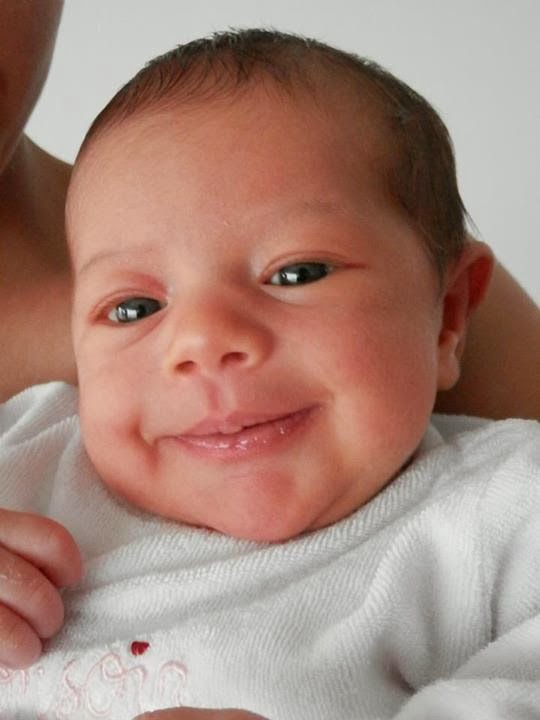
There is one baby however that has truly captured my heart for many reasons these days. And yes, even I find that she's not only exceptionally nice to look at (who could not fall for this cute smile?) but also someone very special, with a really beautiful name to go by: Hypatia. Hypatia Alber.

The little one was just recently born by her mother to the most proudest father you probably can come across, one, who already posted photos of her when she was still inside her mother, constantly having her hands at her head and her head often down to which he excitedly exclaimed: "That's my girl!"

He should know. For he is a man who uses his head a lot himself and almost got killed over this only a year ago: Alber Saber.

For those, who are not familiar with his story, which I wrote about a year ago on this blog (Alber Saber - And all is well in Egypt), let me give you a quick sum up: Egyptian, intelligent, 27 years old, thinking aloud about religion and God and trying to find his way in the labyrinths called religions. A Copt, I should add. And all and all, in the Egypt that was 'ruled' by President Morsi and the Muslim Brotherhood this was a toxic mixture.

A year ago this time, Alber Saber rotted in an Egyptian jail, awaiting the outcome of his trial for alleged blasphemy. In the aftermath of the riots around the vile anti-Islam movie "Innocence of Muslims", tensions against Copts ran high and Alber's posting of his contemplations on religion angered his Muslim Cairo neighbours who on 12 September stormed the house where he was living with his mother and threatened to burn the place down – with them inside. In their fear, mother and son called the police to protect them, but when the Egyptian police arrived and barely were able to make their way through a hateful, shouting mob, there was no interest to protect the Copts. The police sided with those attacking them instead, confiscated Alber's computer and arrested him, leaving the fear stricken mother alone with the death threats hurling crowd.

What followed was horror

Alber they took to the police station where he was thrown into a cell with criminals, not without shouting first that he had insulted God and was an infidel, so that the cellmates turned on him, beat him badly, and one slashed his neck with a razor blade. He had to spend the rest of the night in a corner, bleeding and scared and not knowing if he would ever come out of this alive.

His trial lasted almost three months and was an incredible, hate filled farce. On 12 December the judge ruled that Alber, in criticising religion, had incited 'tensions among Muslims and Christians' and therefor was guilty. The verdict: three years in prison. The chances of him ever getting justice in an Egypt full of sectarian strife under Morsi and the Muslim Brotherhood had been crushed.

Five days later, as an appeal had been launched and due to the publicity his case and the unjust verdict received world wide, Alber Saber was freed on bail until the resuming of his trial in January 2013. On the day his appeal case was to start, Alber Saber had left Egypt. He knew, he would never get justice if he stayed.

The months that followed for him in Europe were both challenging and depressing. The freedom he gained was a wonderful gift, yet being torn apart from his family was extremely hard. He missed his wife, his mother, his friends. But had to grit his teeth and go on. His safety was at stake.

Then slowly things began taking good turns. The family situation became sorted out and a safe place to live was found. With a heavy heart still over Egypt and those left behind Alber Saber started to do what was his right as a young married man, to live and to love. And to become secure in his life.

It was at this time that a little human started to appear on the horizon, shy at first but bigger and bolder as the months went on, and a living proof that even after troubling times in an Egyptian jail good things can come out of it if you are released on bail. For this little one was conceived when freedom was restored, and it was for her the most that Alber had to make sure he would not rot in prison but be free when she would decide to enter this world.

And enter she did. With a smile so cute, it melts your heart, with wide awake, open eyes to observe and take in, with a twinkle in those eyes, as if trying to say that living after all is real fun and should be enjoyed and that sorrows surely are not part of the universe – and if ever they were may easily be forgotten.

Hypatia, as she so beautifully was called, was the biggest triumph over sectarian hate and police brutality and rotting in dark cells with cockroaches, violent guards and aggressive inmates. She was – and is – the epitome of life and what it is all about: Hope and humanity, compassion and happiness, and the wonderful right to own a future. For everyone. Even for her father who, only a year ago, had to endure such horrors.

The truth about being a father

It was one of the most dreaded parts of Mubaraks rantings, when the old dictator kept referring to Egyptians as 'my children'. When he called the men and women of Egypt 'my sons' and 'my daughters', though he never had a hand in their coming to this world and even less in their making a living and being allowed to live. While he named himself their father, he did not hesitate to make their life hell, neglect them, terrorise them, allow them to be beaten, arrested, tortured and even killed. Something a true father would never have done.

After he was gone, others came pretending to be different but picking up the same sick line of 'my children' and the farce of being a loving father. They too now are history, and how much the current strong man of Egypt, el-Sisi, feels to be the father of Egyptians has yet to be seen. But the well known, albeit dreaded, version of fatherly love from above is lurking once more around the corner.

Enters Hypatia again, full of innocence and natural trust, crouching into the arms of her real father, who could not be prouder and happier, and teaching those old Egyptian wanna-be fathers the simple lesson what being a father to a child really means. Three words are needed only: Love, security and trust.

If you see Hypatia's face, you know what Egyptians expect from their fathers and what they deserve. It is, with all those father figures, high time that the expectations finally are met.

If anything, Egypt can learn a lot from Hypatia and her wonderful smile: That it is worth living more than dying, that trust is the essence for happiness, and that without true, compassionate love, people should not even dream of calling themselves fathers. Only in the arms of a father of love, says Hypatia, can I cuddle securely, dream my little dreams of happiness and fall soundly asleep.

Which she promptly does.


Hush, Egypt, hush. It is time to become quite and contemplate what life is really about. From the darkness of jail hell to the brightness of pure happiness is but a short way. Choose the latter, come on. And while you still ponder on this – make sure please that you don't wake the little one. Psssst ...


----------------------------------------------------------------

All pictures © Alber Saber - reproduced with kind permission